
Acoustic Clouds vs. Baffles
When it comes to acoustic ceiling features, there are two options most commonly used: acoustic ceiling clouds and acoustic ceiling baffles. Both help manage sound, but they have some important differences in how they’re built, positioned, and incorporated into a space.
Table of Contents
- Acoustic Clouds vs. Baffles
- What Is the Difference Between Acoustic Clouds and Baffles?
- What Are Acoustic Ceiling Clouds?
- What Are Acoustic Ceiling Baffles?
- How Do Clouds and Baffles Affect the Look of a Space?
- Which Is Better for Your Project?
- Can Acoustic Clouds and Baffles Be Custom Fabricated?
- Related Blog posts
What Is the Difference Between Acoustic Clouds and Baffles?
When comparing acoustic ceiling clouds vs baffles, the biggest difference is orientation.
Clouds are typically suspended horizontally below the structure or main ceiling, creating a floating plane or series of planes. Baffles are suspended vertically, with the acoustic surfaces hanging down into the space.
That difference affects not only the design of the space, but changes how the elements interact with the room and other building systems. Neither one is automatically the better option. They’re different tools, and the right one depends on what the project needs.
What Are Acoustic Ceiling Clouds?
Unlike a traditional continuous ceiling, acoustic ceiling clouds are suspended panels or custom forms installed below the main ceiling to help manage sound. They can be straightforward, flat acoustic panels, or they can be more complex, architectural features.
Ceiling clouds are often used on projects where the ceiling is meant to be part of the overall architectural design.
What Are Acoustic Ceiling Baffles?
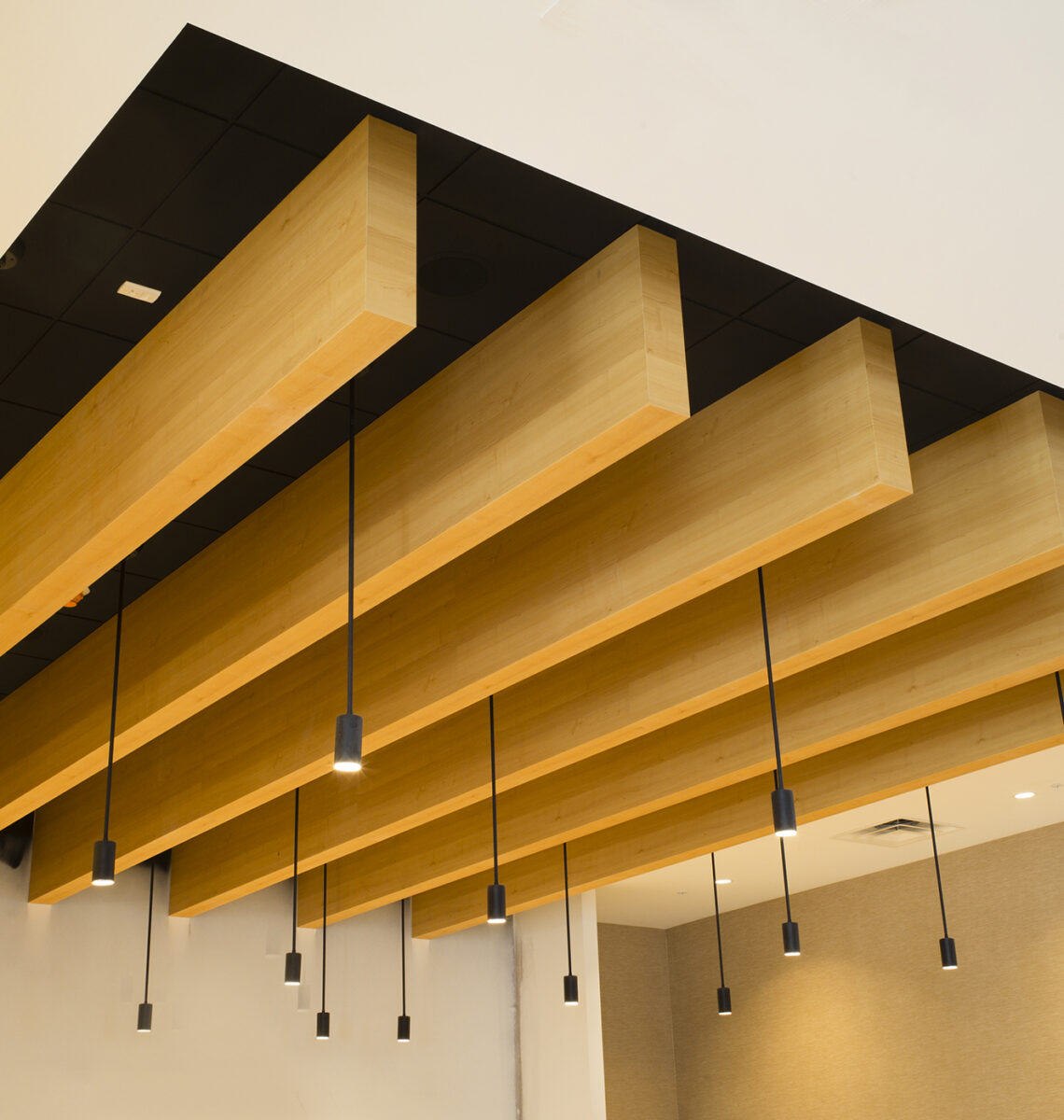
Acoustic ceiling baffles are vertical suspended elements. Instead of creating a horizontal plane, ceiling baffles hang down from the structure above, typically in rows or groups. They can be arranged in consistent lines, staggered patterns, varying heights, or different orientations depending on the design.
That vertical arrangement creates a very different look from a cloud. Acoustic baffles naturally introduce repetition and direction into a ceiling, which can be especially effective in large open spaces. They can also leave more of the ceiling structure visible. That’s useful when exposed ductwork, structure, lighting, or other systems are intentionally part of the design.
How Do Clouds and Baffles Affect the Look of a Space?
The ceiling largely impacts how people feel when they walk into a space, whether they are aware of it or not. Clouds and baffles have very different visual personalities.
Clouds for Large Sculptural Forms
Clouds are a good fit when you want the ceiling treatment to feel more like an architectural feature. They can be large, curved, layered, geometric, or sculptural. Multiple clouds can work together to create a larger visual composition without turning the entire ceiling into one continuous surface.
Because they’re generally horizontal, they can help visually define an area below them, too. That can be useful in open environments where you want to create some separation without building walls.
Baffles for Rhythm, Direction & Repetition
Baffles’ vertical orientation naturally creates lines and repetition. A row of evenly spaced baffles can establish a strong rhythm across a ceiling, while variations in height, spacing, shape, or angle can make the installation more dynamic.
This approach can work particularly well in large spaces where you want to add visual structure without completely closing in the ceiling. And because the elements are individual, there’s often flexibility to work around existing building systems rather than trying to hide everything overhead.
Which Is Better for Your Project?
There isn’t one answer that works for every project. The right choice comes down to the room, the design, and the realities of the building. And remember, the acoustic requirements matter, but they shouldn’t be considered in isolation. Good acoustic ceiling design looks at the entire space and figures out how the acoustic solution fits into the bigger picture.
Ceiling height is one of the first things to consider. You need enough room for the suspended elements to work visually and functionally without interfering with occupants or other systems. Available space matters when acoustic elements are sharing space with other systems such as lighting, HVAC, sprinklers, electrical, structure, or signage.
Then there’s the design itself. Are you looking for a large architectural feature? A repeated pattern? Something that blends in? Something that becomes a focal point?
We recommend bringing a fabricator into these conversations early. The sooner you understand how something will be built, suspended, transported, and installed, the more options you have.
Can Acoustic Clouds and Baffles Be Custom Fabricated?
Standard acoustic products work well when they meet the project’s needs. But not every project fits inside a standard catalog.
Custom fabrication can take acoustic clouds and baffles well beyond the typical rectangular felt panel. Elements can be curved, angled, layered, oversized, dimensional, or designed as part of a larger architectural design. Finishes can also be customized to tie the acoustic elements into the rest of the interior.
A cloud might become part of a sculptural ceiling installation. Baffles might change in height or shape to create a specific pattern. Acoustic elements can be coordinated with lighting, branding, structure, or other architectural details.
This is where custom fabrication expertise really matters. You aren’t just choosing an acoustic product. You’re figuring out how that element needs to work with the design, the building, and the jobsite. We approach these projects from that practical standpoint. We look at the design intent, the acoustic goals, the materials, the surrounding systems, and how the finished pieces will actually be fabricated and installed.
Because the question isn’t always “clouds or baffles?”
Sometimes it’s, “What does this space need, and how do we build it?”
For your custom fabrication and custom fabrication needs, look no further than KMDI, and our use of MicroLite!™, to deliver the best custom design and fabrication experience—in any size, any shape, and any finish.
Contact us today to bring your designs to life.